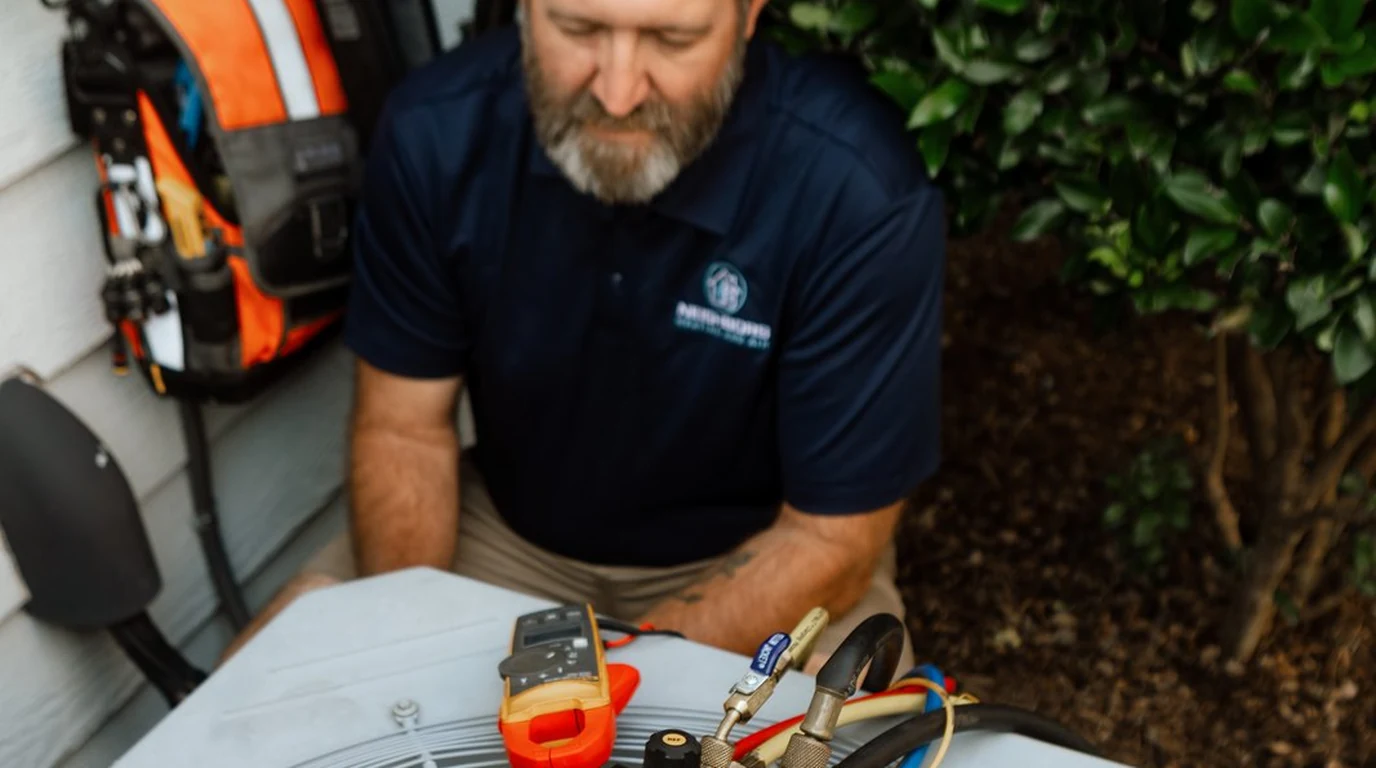
Air conditioners almost never die without warning. Before the big failure, there's nearly always a stretch of warning signs: a sound that wasn't there last month, air that's cool but not cold, a breaker that trips once and gets forgotten. Catch the signal early and you're usually looking at a modest repair. Ignore it through a Carolina July and you're looking at a bigger one, on the system's schedule instead of yours. Here are the seven warning signs we most wish homeowners had called us about sooner, and the first thing to do for each.
1. The air from the vents is warm, or barely moving
What it means: Warm air often points to a refrigerant issue, a dirty coil, or a compressor problem. Weak airflow points to a clogged filter, a failing blower, or ductwork trouble.
Do this first: Check the filter: according to the U.S. Department of Energy, inadequate maintenance (a dirty filter chief among the culprits) is one of the most common causes of air conditioner trouble, and a fully clogged filter can cause both symptoms by itself. Confirm the thermostat is on Cool and the fan is on Auto, not On (with the fan set to On, vents blow room-temperature air between cooling cycles, which feels like a failure but isn't). If the filter's clean and it's still blowing warm, turn the system off to avoid strain and call. Running an AC with a real cooling fault can turn a repair into a compressor.
2. It starts and stops constantly (short cycling)
What it means: A system that kicks on, runs a few minutes, and shuts back off over and over is either shutting itself down for protection (overheating, icing, a pressure fault) or was oversized for the house to begin with. Either way, short cycling is hard miles: the compressor's hardest moment is startup, and short cycling is nothing but startups.
Do this first: Filter again (seeing a theme?), and make sure the thermostat isn't in direct sun or over a lamp: a thermostat that reads hot makes bad decisions. If it keeps cycling, shut it off and have it looked at.
3. New noises: grinding, squealing, rattling, buzzing
What it means: Don't ignore this one. Rattling, grinding, or squealing usually means a loose or failing part (a blower wheel, a fan motor bearing, a failing capacitor's hum) that can turn into a much bigger repair when it finally lets go. A system that's healthy sounds the same today as it did last summer.
Do this first: Turn the system off. This is the sign homeowners most often push through ("it still cools!") and most often regret. A worn-bearing-stage repair and a destroyed blower assembly start out as the same noise, a few weeks apart.
4. Ice on the lines, or water where it shouldn't be
What it means: Ice on the copper refrigerant line or the indoor coil usually means an airflow problem or low refrigerant. Water pooling around the indoor unit usually means a clogged condensate drain (very common in our humidity) or a melted ice problem from the first cause.
Do this first: Turn the AC off and let any ice thaw completely (set the fan to On to speed it up). Running it frozen strains the compressor. If there's standing water, shut it down and deal with it now: ceilings and closet floors lose this race. Our summer maintenance guide covers keeping the drain line clear so it doesn't come to this.
5. The house feels sticky even when it's cool
What it means: Half your AC's job in North Carolina is dehumidifying. If the thermostat says 74° but the house feels like a greenhouse, the system may be running too briefly to wring moisture out (oversizing or short cycling), or it may be losing its ability to do the job at all. Chronic indoor humidity does real damage beyond comfort: it feeds mold, dust mites, and that musty-house smell.
Do this first: Note whether the system runs in short bursts or long steady cycles, and whether the sticky feeling is new this season. That history is genuinely useful to whoever diagnoses it.
6. Your power bill jumped and nothing else changed
What it means: Same house, same habits, same rates, but the bill keeps climbing. Your system is working harder to deliver the same result. Common culprits: a dirty outdoor coil, low refrigerant, a struggling motor, duct leaks pushing cooled air into the attic, or simply a system past its prime.
Do this first: Compare this month's kilowatt-hours against the same month last year (your utility's app shows this) so you're comparing usage, not rates. A tune-up usually finds the cause, and if the honest answer is that the system is wearing out, you'll want our repair-or-replace guide next.
7. The breaker trips, or it needs a "reset" to keep going
What it means: An AC that trips its breaker is pulling more current than it should: often a struggling or locked-up compressor, a wiring fault, or a motor that's hard-starting. A breaker is a safety device doing its job.
Do this first: Check the breaker and flip it once. If it trips again, stop. Turn the system off and call. Repeatedly resetting a tripping breaker is how electrical faults become electrical fires. This is the one item on this list with a genuine safety edge; treat it that way.
The seven warning signs at a glance
| Warning sign | Usually means | Do this first |
|---|---|---|
| Warm or weak air | Filter, refrigerant, coil, or blower | Check the filter; fan to Auto; off + call if still warm |
| Short cycling | Protective shutdowns or oversizing | Filter; shade the thermostat; off + call if it continues |
| New noises | Loose or failing part | Turn it off; don't push through it |
| Ice or water | Airflow, refrigerant, or clogged drain | Off; thaw fully; address water immediately |
| Sticky house | Dehumidification falling behind | Note run patterns; mention it when you call |
| Bill jump | System working harder for the same result | Compare kWh year-over-year; book a tune-up |
| Breaker trips | Electrical fault drawing excess current | Reset once only: trips again, off + call |
Recognize your house in any of these?
Call us: we aim for a 2-hour response window, with same-day appointments available across Gaston County and the surrounding areas. You'll get a plain-language diagnosis and a flat-rate quote before any work starts.
What happens when you call about one of these warning signs
No mystery, no upsell theater. A technician (one who lives around here) comes out, diagnoses the actual problem, and explains it in plain language. You get a flat-rate quote before any work begins, and every repair is backed by at least a one-year workmanship guarantee. If what you really need is a $15 filter and a habit change, that's what we'll tell you.
And if you'd rather catch all seven of these warning signs before they start: that's literally what a maintenance plan is for. Our $199/year Welcome to the Neighborhood plan covers a spring and fall check, priority scheduling, 10% off services, and no diagnostic fees, which means a warning sign costs you nothing to have checked.
Something on this list happening at your place right now? Call (704) 461-0252. We pick up.
Frequently asked questions
What are the most common AC warning signs?
Warm or weak air from the vents, short cycling, new mechanical noises, ice on the refrigerant lines, water around the indoor unit, a sticky-feeling house, climbing power bills, and a breaker that trips. Any one of them is worth a look; two or more together is worth a call.
Why is my AC running but not cooling the house?
Start with the filter and make sure the fan is set to Auto rather than On: with the fan On, vents blow room-temperature air between cooling cycles, which feels like a failure but isn't. If neither fixes it, a refrigerant or compressor issue is likely; turn the system off and have it diagnosed.
Is it safe to keep resetting a tripped AC breaker?
No. Reset it once. If it trips again, something is drawing more current than it should, and repeatedly resetting it is how electrical faults become electrical fires. Turn the system off and call.
What does it cost to have a warning sign checked out?
You'll get a flat-rate quote before any work starts, so the diagnosis never turns into a surprise bill. Welcome to the Neighborhood members pay no diagnostic fee at all, which makes checking a warning sign free.
Last updated June 24, 2026.