By mid-July in Gaston County, your air conditioner isn't cooling your house so much as fighting for it. Afternoons in the 90s, humidity that makes 92° feel like 100°, and a system that may run twelve hours or more a day without a break. This is when weak systems fail, and when a little summer AC maintenance pays for itself. Here's what we'd tell our own family to do, most of it free and none of it requiring tools you don't have.
Why Piedmont summers are so hard on air conditioners
Cooling a house in North Carolina is really two jobs. The first is removing heat. The second (the one that quietly does the damage) is removing moisture. Our summer air carries a heavy load of humidity, and your AC has to wring it out of every cubic foot it cools. That means longer run times, more condensation to drain away, and more strain on the same parts that were already working hard.
Add in pollen, cottonwood fluff, and grass clippings coating the outdoor unit, and you have a machine running its hardest months while it's also at its dirtiest. The good news: the fixes are simple.
1. Change the filter: monthly, in summer
If you do exactly one thing from this list, do this. A clogged filter chokes airflow, makes the system run longer to hit the same temperature, and in bad cases can freeze the indoor coil solid. According to the U.S. Department of Energy, replacing a dirty, clogged filter can lower your air conditioner's energy use by 5 to 15 percent.
In spring and summer around here (peak pollen, windows open, system running constantly), check it monthly. Hold it up to a light: if you can't see light through it, it's done.
Write the date on the filter's cardboard edge with a marker when you install it. Ten seconds now saves the "wait, when did I change this?" debate later.
2. Give the outdoor unit room to breathe
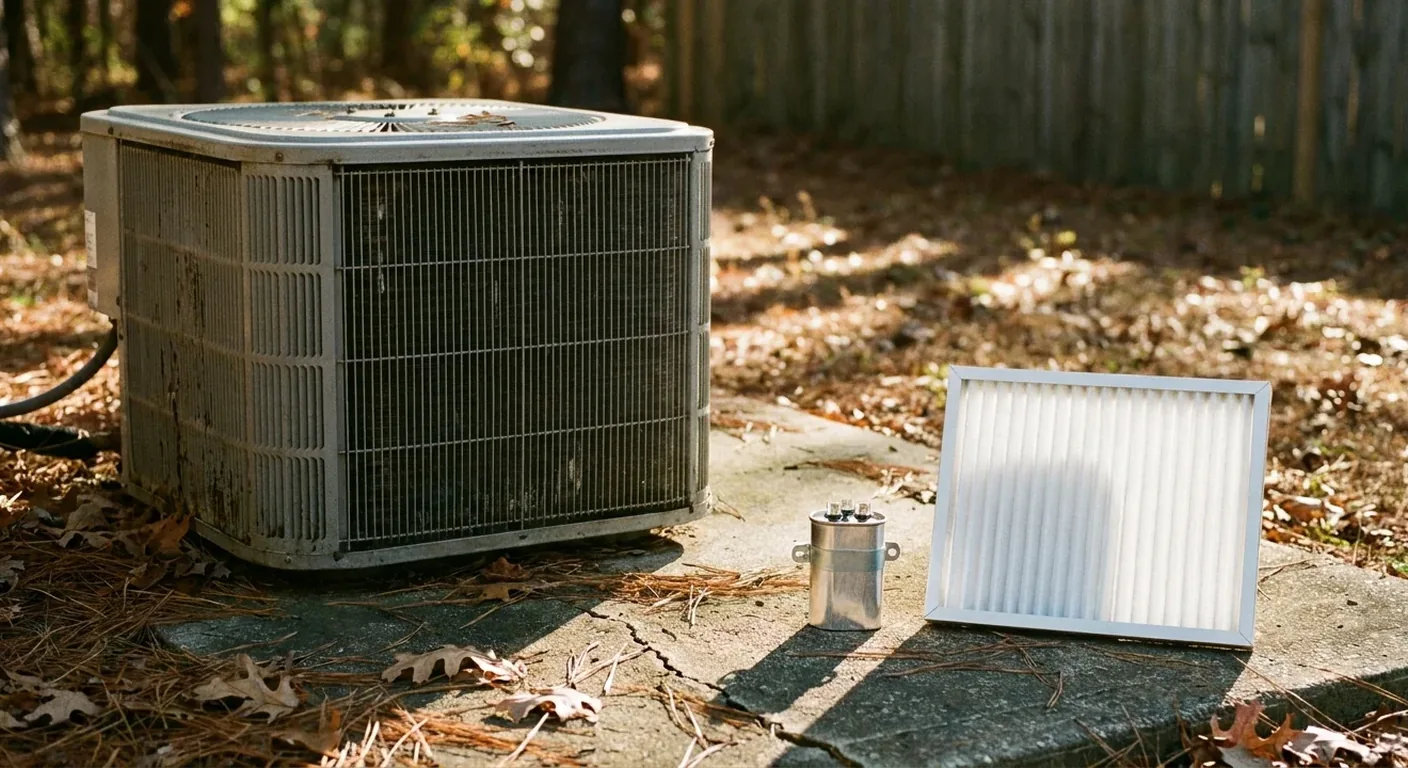
Your outdoor unit (the condenser) dumps all the heat from inside your house into the outside air. It can't do that if it's suffocating. Walk out and look at yours today:
- Two feet of clearance on all sides. Trim back shrubs, ornamental grasses, and that crepe myrtle that's gotten ambitious.
- Clear the coil fins. If the sides of the unit look like a lint trap (grass clippings, cottonwood, dryer fuzz), cut the power at the outdoor disconnect first, then gently rinse the loose surface debris off with a garden hose. Never use a pressure washer; it flattens the fins. The thorough version (flushing the coil from the inside out) is quick for a tech and easy for a homeowner to get wrong, so leave that to a service visit.
- Don't bag it, box it, or build over it. Decorative covers that look great on Pinterest cook condensers in real life.
If the fins are badly matted or bent, that's a job for a service visit: combing fins is easy to get wrong.
3. Pay attention to the drain line
Here's the one almost everybody forgets. All that humidity your AC pulls out of the air has to go somewhere: on a muggy Carolina day, a running system can send gallons of water down a little PVC pipe called the condensate drain. When algae clogs it, the water backs up. Best case, a safety switch shuts your AC off on the hottest day of the year. Worst case (no switch, or a failed one), it overflows into your ceiling or closet.
- Find the drain line's exit point outside (usually a small PVC pipe near the outdoor unit). When the AC is running on a humid day, it should be dripping steadily. Bone dry can mean a clog.
- Water pooling around the indoor unit, or a musty smell near it, means stop and deal with it now: that's warning-sign territory.
A cup of plain white vinegar poured into the drain line's access tee every month or two keeps algae from getting established. Skip the bleach: it's rough on the pipe cement and the drain pan over time.
4. Set the thermostat like you mean it
The biggest summer mistake we see isn't a broken part: it's asking the system to do something physics won't allow. On a 95° afternoon, most residential systems can hold your house about 20 degrees below the outdoor temperature. Cranking the thermostat from 78° down to 68° doesn't cool the house faster; it just makes the system run flat-out for hours.
- Pick a temperature and hold it during the hottest part of the day. Big swings cost more than they save in summer.
- Away for the day? Set it a few degrees warmer, not off. According to the U.S. Department of Energy, a 7–10°F setback for 8 hours a day can save up to 10% a year on heating and cooling. In our humidity, warmer-not-off is the move: a house that's been sealed up at 90° all day takes hours to dry back out.
- Run ceiling fans in occupied rooms. The breeze lets most people raise the thermostat about 4°F with no comfort loss. Turn them off when you leave: fans cool people, not rooms.
5. Fight the heat before it gets inside
Every bit of heat you block is heat your AC never has to remove. Close blinds and curtains on south- and west-facing windows in the afternoon. Save the oven, the dryer, and the dishwasher's heat-dry cycle for the evening. Check that attic-door weatherstripping: on a 95° day your attic can sit at 130° or more, and a leaky hatch pours that heat straight into the hallway.
6. Know the early warning signs
Even good summer AC maintenance can't prevent every failure. Warm air from the vents, ice on the copper line outside, new rattles or squeals, a breaker that keeps tripping: each of those is your AC asking for help while the repair is still small. We wrote a full guide to the seven warning signs worth acting on; it's worth five minutes.
Want a pro to look it over before the next heat wave?
Our $129 Friend of a Neighbor check covers drain lines, capacitors, temperature drop, the blower wheel, and filters, with an honest report on what your system actually needs. Same-day appointments available across Gaston County and the surrounding areas.
Summer AC maintenance: what's yours, what's ours
| You've got this | Call us for this |
|---|---|
| Monthly filter changes | Refrigerant checks and charging (EPA-certified work) |
| Rinsing debris off the outdoor coil | Coil deep-cleaning, bent fins, electrical components |
| Vinegar down the condensate drain | Clearing an actual clog or a tripped float switch |
| Thermostat habits, curtains, ceiling fans | Ice on lines, breaker trips, new noises, weak airflow |
| Keeping 2 ft of clearance around the unit | Seasonal tune-ups and anything involving the sealed system |
None of this is about selling you a service call: most of this summer AC maintenance is free, and it genuinely works. But when your system does need a professional, catching it early is the difference between a small repair and a July weekend with no AC. If something on this list turned up a problem, call us at (704) 461-0252. We pick up, and you'll know the price before we start.
Frequently asked questions
How often should I change my AC filter in a North Carolina summer?
Check it monthly from May through September. With the system running most of the day and pollen season behind it, a filter that would last three months in spring can clog in one. If you can't see light through it, replace it.
What summer AC maintenance can I safely do myself?
Filter changes, gently rinsing the outdoor coil with a garden hose (power off at the disconnect first), pouring vinegar down the condensate drain line, keeping two feet of clearance around the unit, and smart thermostat habits. Leave refrigerant, electrical components, and anything inside the cabinet to an EPA-certified technician.
What should I set the thermostat to when I'm away for the day?
A few degrees warmer than your normal setting, not off. In Piedmont humidity, a house that sat sealed at 90° takes hours to cool and dry back out, which erases most of the savings and leaves the house clammy all evening.
How much does a professional AC tune-up cost in Gaston County?
Our Friend of a Neighbor check is a flat $129: drain lines, capacitors, temperature drop, blower wheel, and filters, with an honest report on what your system actually needs. The $199/year Welcome to the Neighborhood plan covers both a spring and a fall visit, plus priority scheduling, 10% off services, and no diagnostic fees.
Last updated July 14, 2026.
Sources & further reading
- U.S. Department of Energy: Maintaining Your Air Conditioner (archived) (filter savings estimate)
- U.S. Department of Energy: Energy Saver Guide (PDF) (thermostat setback and ceiling-fan guidance)
- U.S. Department of Energy: Home Cooling 101 (PDF)
- ENERGY STAR: Heating & Cooling at Home