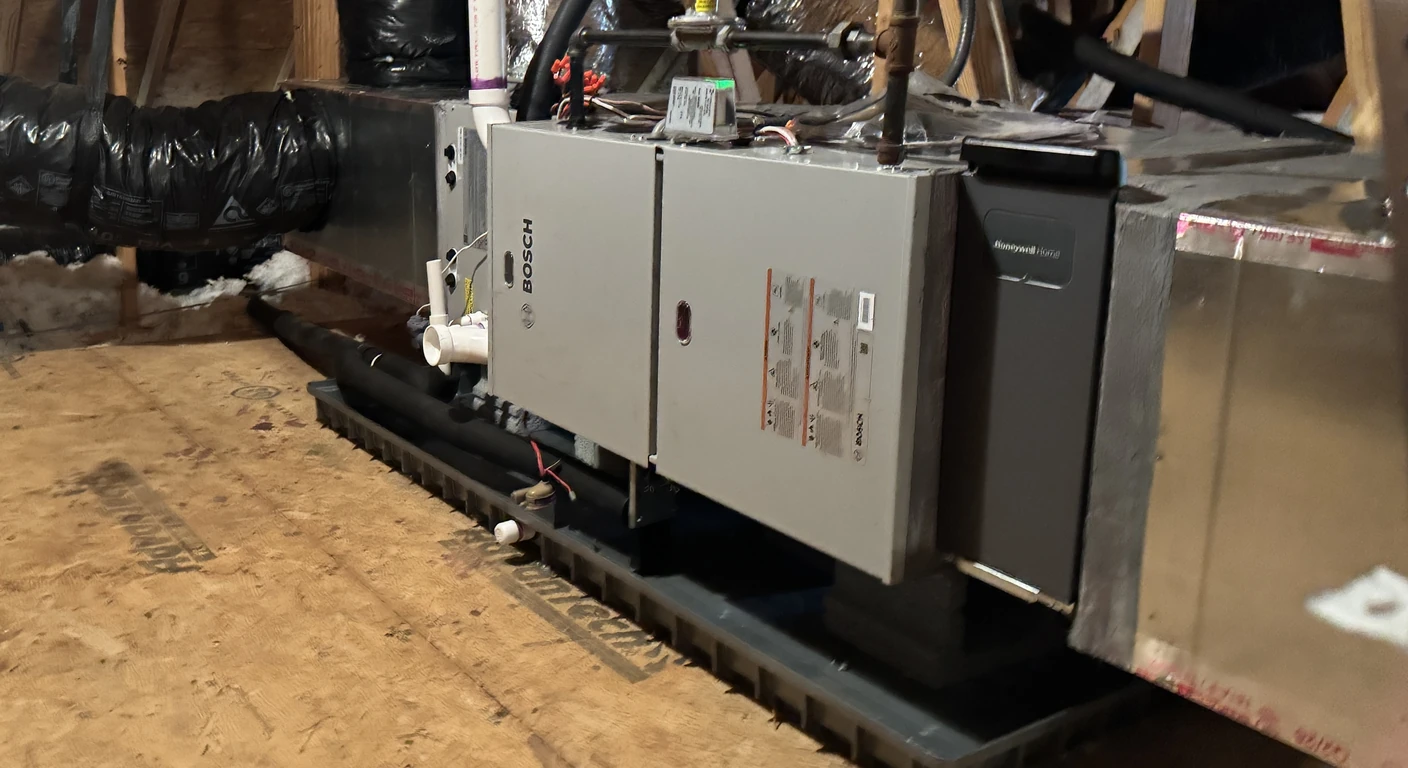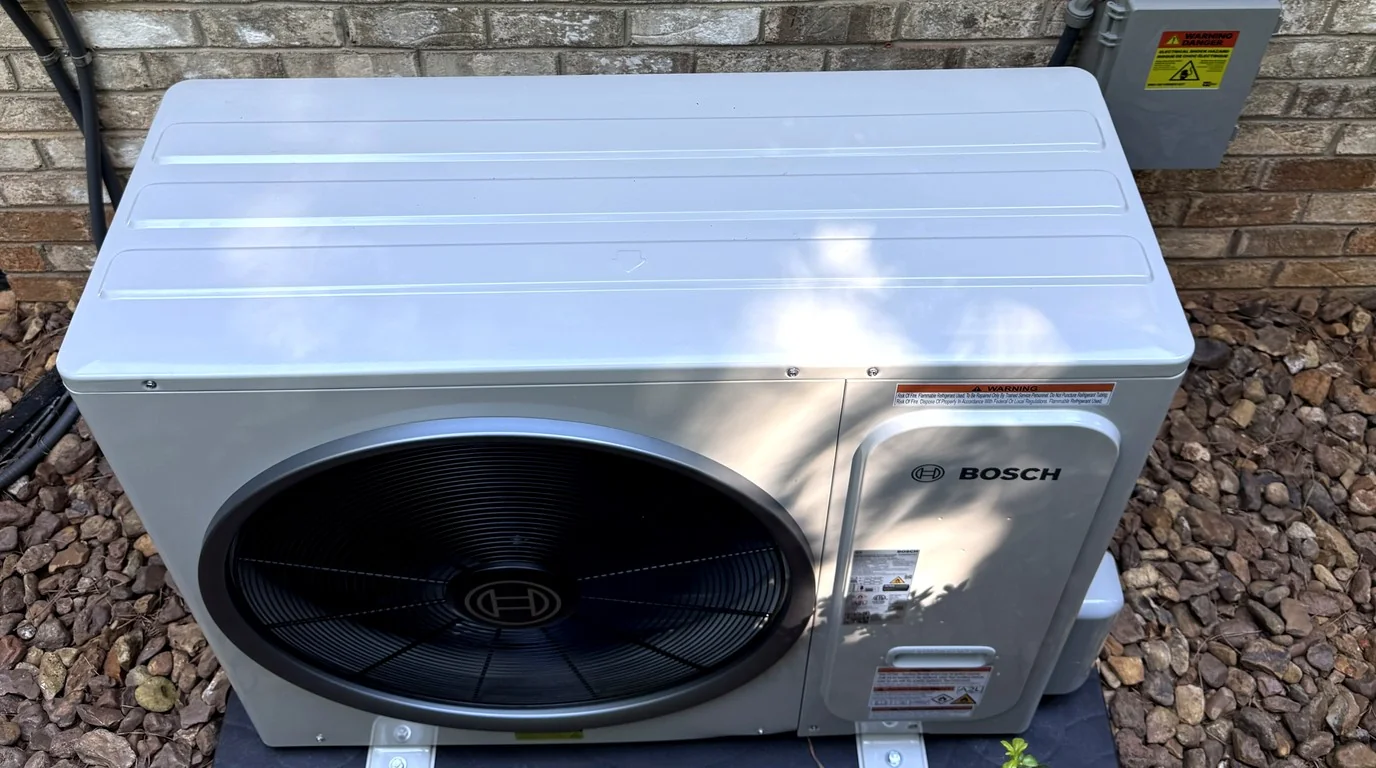
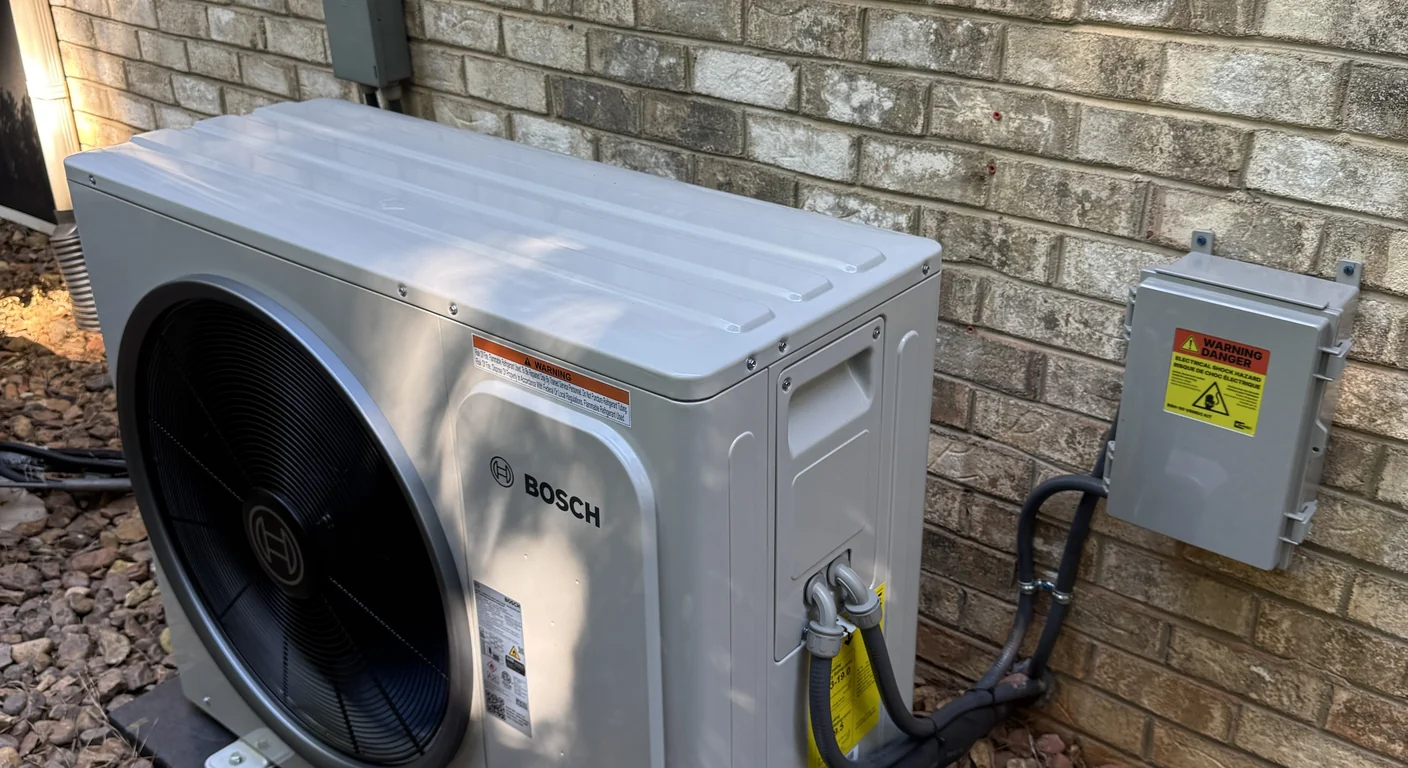
HVAC installation cost in Gaston County has no published local number, so the honest starting point is the national 2026 guides: $5,000 to $12,500 for a straight replacement of a central system for most homes, with new ductwork pushing it past $15,000. That range isn't ours. Angi (updated August 3, 2026) puts a full HVAC replacement at $5,000 to $22,000 with an average of $7,500, and says most homeowners pay $5,000 to $12,500. This Old House (updated June 12, 2026) gives the same $5,000 to $12,500 for a standard-efficiency air conditioner and furnace with simple ducts. HomeGuide (2025 edition) says a change-out that keeps the existing ducts runs $5,000 to $11,000, and $7,000 to $16,000 once new ductwork is in the job.
Those are published guides, not our quotes. What we do is give you one written price for your house before anything is ordered, and a repair price next to it if a repair is still on the table. JR Buchanan has 27 years in heating and air and holds NC license #37008. Here is what moves the HVAC installation cost in Dallas, Belmont, Mount Holly, Cramerton and Gastonia, and the part a national range can't tell you about your house: the ducts.
Want the number for your house? Call (704) 461-0252 or request a written quote. JR looks at the equipment and the ducts, and you get one price before anything is ordered.
HVAC installation cost by job: AC only, AC with a furnace, or a heat pump
The first thing that sets your HVAC installation cost is what is being replaced. A home with a gas furnace and a separate air conditioner can replace one or both. A home with a heat pump replaces the heat pump, which heats and cools in one piece of equipment. The guides price these three jobs differently, and the spread between them is the honest answer.
| Job | Angi (2026) | This Old House (Jun 2026) | HomeGuide |
|---|---|---|---|
| Central AC only (condenser and coil) | Average $5,978; most pay $3,887 to $8,073 (Oct 22, 2026) | $4,000 to $8,000 | $5,000 to $8,300 entry level; $8,300 to $12,500 mid-range |
| Gas furnace only | $3,800 to $10,000; about $7,000 for 1,600 to 2,000 sq ft (Jul 8, 2026) | $3,800 to $10,000 | $3,000 to $10,000+ |
| AC and furnace together | Average $7,500; most pay $5,000 to $12,500 (Aug 3, 2026) | $5,000 to $12,500; premium systems in large homes exceed $22,000 | $5,000 to $11,000 with existing ducts; $7,000 to $16,000 with new ducts (2025) |
| Heat pump system | Average $6,087; most pay $4,236 to $7,942 (Aug 3, 2026) | $4,500 to $8,000 | $3,800 to $8,200 on its system page; $10,000 to $25,000 on its heat pump page |
| Ductless mini-split, one zone | $2,000 to $5,000; multi-zone $3,200 to $14,500 (Apr 4, 2026) | $1,500 to $4,000 AC; $1,300 to $8,000 heat pump | $2,500 to $6,000; two zones $4,500 to $8,000 |
Two notes on that table. Angi and HomeAdvisor are the same company, so they count as one source. And HomeGuide's two heat pump figures disagree with each other, so we left both in. For a North Carolina figure, according to HVAC.com (June 2025), a 3-ton heat pump with an air handler runs $10,000 to $13,000 installed.
What moves the HVAC installation cost: size, efficiency, brand and labor
According to Angi, This Old House and HomeGuide alike, the same four levers set the HVAC installation cost. Size comes first: a 2-ton system for a small ranch and a 4-ton system for a two-story house are different equipment at different prices, and the right size comes from a load calculation on your house, not from whatever the old unit says on its label. Efficiency is second. Angi says each step up in SEER rating adds $350 to $1,500 to the equipment, and its heat pump guide prices a bare unit at $1,600 to $4,900 at SEER 14 against $3,600 to $9,500 at SEER 20. Brand tier matters less than people expect, but a premium line costs more than a builder-grade line of the same size. Labor is the rest: HomeGuide puts installation labor at $1,000 to $3,000 at $75 to $150 an hour, and Angi budgets about $1,500 for labor plus $250 to $400 for the permit.
Then there are the add-ons that turn a $7,500 HVAC installation cost into a $12,000 one. Angi's own sample budget shows it: central air at $3,900 to $7,900, labor around $1,500, a permit at $250 to $400, and optional ductwork at about $3,500. Angi totals that at $5,650 to $9,800 with the ducts you have, or $10,770 to $15,060 once the optional items are added. Zoning, a smart thermostat and a higher-efficiency furnace all move the number the same direction.
The duct question: why HVAC installation cost runs higher in older Gaston County homes
This is the part of the HVAC installation cost that surprises people, and it's the part that matters most around here. Gaston County's housing is old by the numbers: the Census Bureau's 2020 to 2024 American Community Survey (via Census Reporter) puts the county's median year built at 1982, with 47 percent of its homes built before 1980. Dallas itself is newer on paper, a median year built of 1998 with 38 percent of homes from before 1980 (the town is small, so the Census margin is wide), but a 1998 house is 28 years old this year, and HomeGuide gives ductwork a life of 10 to 20 years. In other words, even in the newer neighborhoods, the original ducts are often near the end of their design life by the time the second or third system goes in, which is why we look at them before quoting rather than assume either way.
Around Dallas and the county's older neighborhoods, a lot of those ducts run through a crawlspace. Crawlspace ducts take on moisture, lose their insulation, come apart at the joints, and were often sized for a smaller system than the house has now. HomeGuide notes that labor goes up for rerouting ductwork, cutting into floors or ceilings, or working in older homes, and that contractors recommend cleaning, repairing or encapsulating a crawlspace before new ducts go in. That is why two HVAC installation cost quotes for the same equipment can be thousands apart: one of them looked under the house.
The payoff is real, though. According to HomeGuide, homeowners who replace leaky ducts can save 10 to 40 percent on energy bills, and a new system attached to ducts that leak a good share of its air is a new system that never reaches its rating. Our Dallas service page covers the airflow and draft problems we see in the older homes there, and our Gaston County page lists every town we work in.
Duct repair, sealing or replacement: what each adds to the HVAC installation cost
The guides put a wide range on the duct share of HVAC installation cost, and the per-foot figures disagree so much that totals by home are the more useful number. HomeGuide (2025 edition) prices full ductwork replacement at $1,400 to $5,600, or $25 to $55 per linear foot, and breaks it out by location: $3,000 to $7,300 in a crawlspace, $2,200 to $5,600 in an attic, $1,800 to $3,100 in a basement. HomeAdvisor (2025 data) gives $10 to $40 per linear foot for new ducts and $30 to $50 per foot to retrofit, and says labor is about 60 percent of a duct project.
Smaller jobs cost less: HomeAdvisor puts minor duct repairs at $200 to $700, sealing at $400 to $1,900, and adding a vent at $250 to $500. Angi's AC guide (October 22, 2026) says ductwork changes add $3,000 to $7,500 to an air conditioner replacement, in line with HomeGuide's crawlspace range. When we quote a replacement, the duct work is its own line, with what is wrong and what fixing it costs, so you can decide whether to do it now, later, or not at all.
The refrigerant change: what a new system runs on now
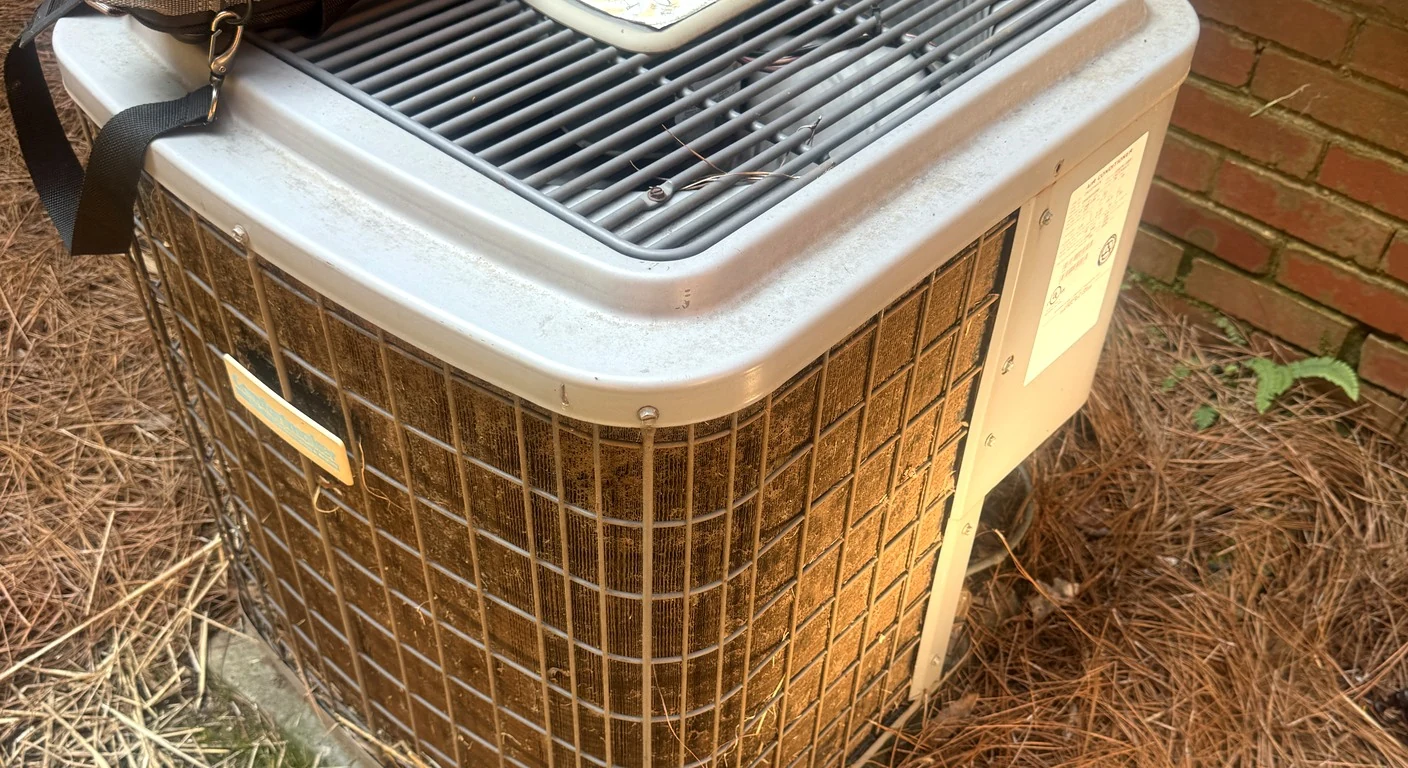
New air conditioners and heat pumps sold today run on a different refrigerant than the one in most Gaston County backyards. The EPA's technology transitions rule (page updated August 28, 2026) set a global-warming-potential limit of 700 for new residential equipment as of January 1, 2025, which rules out R-410A in newly built units; the replacements are the A2L refrigerants, R-454B and R-32. The rule doesn't make your current R-410A system illegal, doesn't force you to replace it, and doesn't ban installing R-410A equipment built before January 1, 2025, so some shops still have stock. Where the squeeze lands is on R-410A refrigerant and service parts over time, which is why an older leaking system gets more expensive to keep alive each year; our furnace repair cost guide and heat pump repair guide cover that side of the math.
Efficiency minimums, and why rebates ask for more
North Carolina is in the Department of Energy's Southeast region, where the minimum for a split air conditioner under 45,000 BTU is 14.3 SEER2 (heat pumps: 14.3 SEER2 and 7.5 HSPF2 nationally). Everything sold new here meets that, so "high efficiency" on a quote means something only above 14.3. Duke Energy's rebate tiers start at 15.2 and 16 SEER2, so the cheapest legal system qualifies for nothing; a quote that lists each model's SEER2 and HSPF2 lets you see whether a rebate is in reach and what the step up costs (Angi: $350 to $1,500 per SEER step).
Not sure what your ducts need? That is the first thing JR checks on a replacement quote. Call (704) 461-0252 or ask for a written quote.
Rebates against the HVAC installation cost in November 2026: what is gone and what is left
The federal tax credit is gone for new installs. The IRS page for the Energy Efficient Home Improvement Credit (reviewed April 28, 2026) says you can claim it for improvements made through December 31, 2025. A heat pump installed in 2025 can still be claimed on the 2025 return, up to $2,000, on Form 5695. A system installed in 2026 gets no federal credit. If a quote still mentions the credit, it's out of date.
Duke Energy still pays, if Duke is your electric utility. Gastonia runs its own municipal electric system, so Gastonia addresses are outside these rebates; most of the rest of the county is Duke Energy Carolinas. Duke's HVAC replacement rebate (effective May 7, 2025) lists $600 for replacing electric strip heat with a heat pump at 15.2 SEER2 and 7.5 HSPF2, $1,000 at 16 SEER2, $500 for replacing an existing heat pump at 15.2 SEER2, and $300 for replacing an existing air conditioner at 15.2 SEER2. A free Duke Home Energy Check is required, before the install or within six months after (twelve months for an emergency replacement). The tiers are written around replacing strip heat, a heat pump, or an AC; a gas-furnace home switching to a heat pump doesn't fit neatly in any of them, so ask before counting on it.
Energy Saver NC is income-qualified. The state's Energy Saver North Carolina program offers up to $16,000 (HOMES) or $14,000 (HEAR) to households under 150 percent of area median income, but since September 1, 2026 HEAR no longer covers replacing a gas appliance, so a furnace-to-heat-pump swap appears not to qualify there. Piedmont Natural Gas has offered furnace rebates in the past; check with Piedmont for current amounts.
How long a system should last, and when replacing is the honest call
The guides land close together: HomeGuide gives a central air conditioner 15 to 20 years, a heat pump 10 to 15 (15 to 20 with maintenance), a furnace 15 to 30, and the Department of Energy's Energy Saver Guide (2022) says to start considering replacement past 10 to 15 years.
Age alone doesn't decide whether the HVAC installation cost is worth paying. We weigh the repair price against the replacement price, the refrigerant the system runs on, whether it holds its charge, and how many more seasons it honestly has. You get both numbers before you decide. The framework is in our repair or replace guide, and the short version is that a twelve-year-old system with one failed part is usually a repair, while a twenty-year-old R-410A system with a leak is a conversation.
Paying for it
The HVAC installation cost is the biggest check most homeowners write on their house between roofs. Financing on installs is available through Hearth, subject to approval, with the prequalification link on our home page. Prequalifying doesn't affect your credit score and doesn't commit you to anything; it just tells you what a monthly payment would look like next to the quote. There is also the slower path: if the system is limping but running, a Welcome to the Neighborhood plan visit at $199 a year can catch a failing part before January and buy time to plan the replacement instead of rushing it on the coldest night of the year.
What a good written quote should itemize
Whoever you call, the HVAC installation cost quote should let you compare apples to apples. The quote should name the exact model numbers for the outdoor unit, indoor coil or air handler, and furnace, with each one's SEER2, HSPF2 or AFUE. Next, the refrigerant. Then the tonnage, with a line on where that size came from. After that, a split between equipment, labor, permit, thermostat, duct work, and removal and disposal of the old system. The warranty belongs on there in two parts, parts and labor, with the years for each. Finally, what happens at start-up: the readings the technician takes to prove the system is charged and moving the air it is supposed to. If a quote is one number on a business card, you can't tell what you are buying. Ours is written, and the price on it's the price.
Frequently Asked Questions
What is the average HVAC installation cost in Gaston County?
No published guide prices Gaston County on its own. The national guides updated in 2026 put a full AC and furnace replacement at $5,000 to $12,500 for most homes (Angi, This Old House), with an average of $7,500, and HomeGuide puts a change-out with existing ducts at $5,000 to $11,000. New ductwork adds $3,000 to $7,500 (Angi) and can push a job past $15,000.
How much does AC installation cost in Dallas NC?
For a central air conditioner alone, Angi's October 2026 guide reports an average of $5,978 with most homeowners paying $3,887 to $8,073, and This Old House gives $4,000 to $8,000. Dallas homes with crawlspace ducts should budget for a duct inspection, since HomeGuide prices crawlspace duct replacement at $3,000 to $7,300.
Is there still a tax credit against HVAC installation cost in 2026?
Not a federal one. The IRS says the Energy Efficient Home Improvement Credit applies to improvements made through December 31, 2025. Duke Energy's rebates ($300 to $1,000 depending on what you replace and the efficiency tier) are still listed as of this writing for homes Duke serves (Gastonia has its own city electric utility), and Energy Saver NC is available to income-qualified households.
Do I have to replace my R-410A system because of the refrigerant rule?
No. The EPA rule applies to newly manufactured equipment, and it allows installation of R-410A systems built before January 1, 2025. Your existing system can be serviced and repaired. The cost of R-410A refrigerant and service parts is the thing to watch over the coming years.
Which towns do you cover for HVAC installation?
Belmont, Mount Holly, Cramerton, Dallas, Gastonia and the rest of Gaston County, plus Hickory. Call (704) 461-0252 or book online, and you get a written price for your house before anything is ordered.
Last updated November 4, 2026.
Sources
- Angi: How Much Does HVAC Replacement Cost? (updated August 3, 2026)
- Angi: How Much Does AC Replacement Cost? (updated October 22, 2026)
- Angi: Heat Pump Costs and Installation Costs (updated August 3, 2026)
- Angi: How Much Does a Gas Furnace Cost? (updated July 8, 2026)
- Angi: How Much Does It Cost to Install a Mini-Split? (updated April 4, 2026)
- This Old House: HVAC Installation Cost (updated June 12, 2026)
- HomeGuide: How Much Does a New HVAC System Cost? (2025 edition)
- HomeGuide: How Much Does It Cost to Install or Replace Ductwork? (2025 edition)
- HomeAdvisor: How Much Does It Cost to Install Ductwork? (2025 data)
- HVAC.com: How Much Does a Heat Pump Cost in North Carolina? (June 2, 2025) and HVAC Replacement Costs in Charlotte (December 17, 2024)
- EPA: Technology Transitions HFC Restrictions by Sector (updated August 28, 2026)
- Lennox: R-454B refrigerant
- ACHR News: HVAC Equipment Prices Expected to Keep Rising (June 10, 2024) and HVAC Price Increase List (May 7, 2025)
- Contracting Business: A2L Refrigerants, Tariffs and More for 2026 (December 10, 2025)
- U.S. Department of Energy: 2023 Central Air Conditioner Standards FAQ (October 5, 2022)
- IRS: Energy Efficient Home Improvement Credit (reviewed April 28, 2026)
- Duke Energy: Rebate for HVAC Replacement (effective May 7, 2025)
- NC DEQ: Energy Saver North Carolina and its program changes page
- Census Reporter: Gaston County, NC (ACS 2020 to 2024 five-year estimates, tables B25034 and B25035)
- U.S. Department of Energy: Energy Saver Guide (2022)